Showing posts with label toastmasters. Show all posts

Tuesday, January 22, 2013

Toastmasters Speech #6


Creating the Best Toastmasters Experience
 

What is the purpose of a Toastmasters club?

·       To create an environment in which you can acquire and practice communication and leadership skills

·       To offer a path to express your passions and, ultimately, who you are
 

How can we help create an environment that supports these goals?

·       Provide mutual support for each other

·       Maintain regular attendance and involvement in meetings

·       Volunteer for weekly roles

·       Take responsibility for advancing in the CC & CL workbooks

·       Promote Toastmasters through PR and word-of-mouth

·       Greet and welcome each other – both current and new members

·       Encourage each other to participate in meetings

·       Encourage each other complete educational goals

·       Stay informed about developments in our club and Toastmasters

·       Develop and maintain a formal mentorship program

·       Create a formal intention, or mission statement, for our club


Monday, November 19, 2012

Toastmasters Speech #5


12 Tips to Lighten Up Your Holiday Season


  1. Prioritize! Ask yourself what is most important about the holidays, and then schedule your holiday calendar according to those priorities. Avoid activities that don’t bring you some sense of satisfaction. Keep in mind, however, that important may not always equate with enjoyable. You might find that spending time with your partner’s family is less than satisfying, but you know that it is very important. Conversely, while you may enjoy attending every holiday party to which you are invited this season, it might be more important to reserve some of your time and energy for family, or simply for yourself.

  1. Prepare a budget. Plan for all the various holiday categories such as gifts, cards, food, travel, events, etc. It is remarkably easy to overspend this time of year (the retail industry counts on it!). Being armed with a well-thought-out spending plan will reduce the likelihood that you will enter the New Year in the red. Keep a record of your budget and what you actually spent for next year’s planning.

  1. Inventory your holiday stuff. Don’t be tempted by the barrage of holiday decorations, gadgets, and goodies on display. Taking stock of what you already have will help you avoid those impulse purchases. Get your holiday gear out early enough so you can do an inventory (and, at the same time, cull unwanted items).

  1. Shop online. Avoid the crowds in the malls and post offices by shopping online. Gifts purchased over the Internet can be gift-wrapped and shipped directly from the retailer, saving you precious time and resources. And, not only will you significantly reduce your level of stress, but you will also be less inclined to purchase those holiday baubles tempting you in the checkout lines.

  1. Shop creatively. Shop for gifts at thrift stores, yard sales, consignment shops, antique stores, and estate sales. The San Luis Valley has a plethora of unique shopping venues that encourage reuse — take advantage of our impressive local resources while supporting the recycling effort.

  1. Plan your holiday gift giving. Before you hit the malls or cyber stores sit down and list each recipient on your gift list. Then write down your gift ideas for each person. In some cases, you may be able to determine exactly what you intend to purchase before you even begin shopping. For those difficult-to-buy-for individuals, brainstorming on paper often saves hours of frustration wandering through the malls searching for inspiration. Planning ahead will make your shopping experience more efficient, productive, and enjoyable. You will also be less inclined to shop impulsively.

  1. Give gifts sparingly. Don’t feel obligated to give everyone you know a gift this season. If you want to show you care, a card will often suffice. A photo (of you, your family, or your pet) is another low-clutter, personalized offering, which can even slip right in with a card. When you do give gifts, avoid going overboard with multiple gifts. (Anyone with a small child in the family can attest to the troubling phenomenon of excessive present giving.) More gifts mean more holiday clutter, so keep it in check.

  1. Send alternative greeting cards. Avoid holiday card waste by sending e-cards. There are numerous free and for-pay e-card companies on the Internet. You can also use their services to “e-vite” guests to holiday parties. Or reuse old cards saved from last year. Simply cut the front side to make a postcard, or paste onto construction paper to create a new card. These make great projects for children!

  1. Avoid gifts that encourage clutter. For example, give consumables (gifts with a finite lifespan) such as food, beverages, homemade goodies, plants, or flowers. Another way to limit holiday clutter is to give gift certificates for services such as massage, spa treatments, catering, housecleaning, etc.

  1. Consider participating in a gift exchange. A clutter-reducing option to traditional gift giving is the gift exchange. One way to do this is for everyone in a particular group (family, friends, co-workers) to provide a single generic gift. Gifts can be distributed in any number of ways: drawing numbers, rolling dice, holding a raffle, or playing games. A variation on the gift exchange is one in which participants draw the recipient’s name ahead of time and offer their present anonymously. Much of the fun is in trying to guess one’s donor.

  1. Give to charity. Consider donating your time or resources to a local food bank, shelter, or favorite charity. You might also give a donation on behalf of someone on your gift list in lieu of giving a traditional gift — a marvelous way to reduce holiday clutter.

  1. Forgo gifts altogether. Instead of exchanging gifts, pitch in for a special dinner at a favorite restaurant. Or plan an excursion to a holiday event, a cultural activity, or winter vacation out of town. Such activities will generate holiday memories, not holiday clutter.

Monday, October 22, 2012

Toastmasters speech #4


Tips to Lighten Up Your Organizing Project


How many of you feel that you could be better organized in your home, office, or life? It is such a common problem that there is an army of experts out there eager to help you—they are called professional organizers. I have been one for the past eight years, and I have helped countless people, like you, to get more organized. Today, I’d like to share with you two important principles and five basic steps for taking on any organizational project.


Organizing Principles

The FIRST organizing principle is SIMPLIFY. Aim for the simplest solution possible. Try to steer clear of organizational solutions and systems that are complicated or require a lot of maintenance. You will only be frustrated and possibly be even more overwhelmed than you were before getting organized.

The SECOND organizing principle is PERSONALIZE. The best organizing system for you is one designed to meet your individual needs. It should be able to accommodate your distinct preferences and requirements. Remember, it works if, and only if, it works for you.


Five Steps of Successful Organization


The FIRST step is to ASSESS & STRATEGIZE. Before you dive into your clutter you must first stand back and take an objective look at your organizational issue. What’s the problem? What’s working? What isn’t? Next, assess your own motivation for getting organized. Why do you want to get organized in the first place? What is your idea of successful organization? How would your home or office look and feel if you were to achieve your ideal? What area needs the most help right now and what would give you the most satisfaction and sense of peace if it were organized? Are there other factors to be considered, such as time, money, space, or health? Then devise a plan based on your assessment. Having a strategy greatly simplifies and expedites the organizational process.

The SECOND step is to PURGE. With a good plan in hand, you are now ready to begin the purging process. Your plan, itself, should dictate the organizational decisions you may face. An important part of the purging process is asking yourself which items are most essential to you. Then, dispense with all items that are unwanted or unneeded. You will find it helpful to have four containers with you as you purge: Donate, Recycle, Trash, and (if you’re ambitious) Sell. Continue this process until you feel you have purged all that does not serve your organizational plan. But keep in mind that you will return to the purging process on an ongoing basis. Purging is one of the most critical elements of clearing clutter and creating order because it constantly removes that which is nonessential and even detrimental to you.

The THIRD step is to SORT. Once you have removed all the things that do not serve your plan, you can begin the process of sorting. There is no correct way to sort. You might wish to categorize by placing like with like or things used in the same location. How you group things is a personal choice, but it should always be determined by your plan. Be prepared to purge more items during the sorting process when it becomes clear that certain objects are no longer necessary or desirable. Continue sorting, resorting and, when necessary, purging, until you are confident that what you truly want or need is what remains.

The FOURTH step is to CONTAINERIZE. During this step you will place each of your belongings into its proper home or storage location. Of course, you can’t know what type of storage is required until you have thoroughly planned, purged, and sorted, so don’t make the mistake of trying to guess what storage system will be needed ahead of time. As with the previous stages, keep your storage solution as simple and user-friendly as possible. There are endless storage and organizational products available on the market. Shop wisely, be creative, and always keep in mind your overall goal. Be wary of products that look nice but aren’t functional, or which require far too much maintenance.

The FIFTH step is to MAINTAIN. Now that you’ve put your organizational system into place, enjoy it! Use it. You will want to modify your system as you use it, if you find it is not meeting your needs in some way. Be prepared to alter any aspect of your plan that is no longer working for you. This routine maintenance and modification will keep your system tailored to your changing needs.
 

Remember that organization is an ongoing process in which you will constantly simplify, personalize, assess, strategize, purge, sort, containerize, and maintain. Make organizing a continual part of how you relate to the things in your life. It is guaranteed to make your experience of your belongings more meaningful and efficient.

Tuesday, October 16, 2012

Toastmasters Table Topic


Don’t ask what the world needs. Ask what makes you come alive and go do it. Because what the world needs is more people who have come alive.

-- Howard Thurman (1899-1981), influential African-American author, philosopher, theologian, educator, & civil rights leader

What makes you come alive?

Tuesday, September 25, 2012

Toastmasters speech #3


THE MAGIC OF FANTASY


Witches and wizards riding on broomsticks and casting spells.
Hobbits on heroic quests.
Dragons that fly and breathe fire.
Trees that can walk and talk.
Werewolves fighting  vampires.
Trolls and goblins and elves and dwarves and fairies and munchkins.

This is the stuff of the fantasy novel. And I confess that this is the stuff I been enthralled with for the past five years. I’d like to tell you why.

But first, what is fantasy? Fantasy is fiction that partakes of the supernatural, and the magical, usually in a pre-modern or medieval or historical setting. Think of J.R.R. Tolkien’s The Lord of the Rings and The Hobbit. But the magic sometimes takes place in a contemporary setting. Think of J.K. Rowling’s Harry Potter series and Stephanie Meyer’s Twilight series.

Science Fiction, however, is similar to fantasy, but science fiction tends toward a futuristic world where what is imagined is more plausible or realistic than in fantasy novels. There is an emphasis on science and technology whereas fantasy relies more on magic. Think of the Star Wars epic.

Both fantasy and science fiction are sub-genres of what is called speculative fiction, which also includes horror and utopian fiction, and superhero fiction, among other genres.

Speculative fiction is easy to find in popular culture in TV, movies, role-playing board games, computer games, comic books, and in the form of a vast fandom.

I may not attend sci-fi conferences or play fantasy computer games, but I love to read fantasy novels.

Let me give you some reasons why I like to read fantasy novels:

  1. I get to escape into another reality, another world.
  2. I love the authors’ imagination, how they can create such fantastical worlds.
  3. I get to experience adventure and excitement vicariously through the characters.
  4. There is something so appealing about following the heroes and heroines as they conquer evil.
  5. I love the magical elements, such as wizards, elves, dragons, and trolls.
  6. I especially enjoy the epic series, where the volume of writing allows the reader to follow the development of the characters and the plot over an extended period of time. A great example of this is Robert Jordan’s Wheel of Time series, which consists of fourteen books, each over 1000 pages in length.
What I don’t like about fantasy is the tendency to include violence and warfare as well as occasional sexism among the characters.

So, it may be true that I’m channeling a thirteen-year-old boy, but I don’t mind – as long as I get to escape into that wonderful world of magic.


Wednesday, September 5, 2012

collecting ourselves

My second Toastmasters speech:


Collectors and what they collect fascinates me. But why we collect interests me even more, because collecting, I would argue, is directly linked to our sense of identity. Our collections tell us much about who we are, how we see ourselves, and who we want to be. I’d like to explore this idea from a few different angles, which I’ll call memory, value, method, and identity.

Memory is a powerful motivator when it comes to collecting. What we collect often reminds us of something, somewhere, someone, or sometime. For many of us, collections are often linked with a sense of nostalgia – for another time in one’s own life, or for another era altogether. The Teddy Bear collector, for example, might associate her collection with a beloved relative, or a fond memory from childhood. Or there’s the person who collects a T-shirt from every place he’s traveled, as a way of capturing his memories of each location.

My penguin collection includes figurines acquired as recently as last month, yet my collection will always have a link to my childhood, which is when I first started collecting penguins. And each penguin has its own story and memory associated with it. So, physical objects seem to connect us, particularly collectors, to other people, places, and times in very powerful and positive ways.

The memories associated with our collections are clearly quite compelling, but so are the other ways in which we place value on our collections. For some, collecting is a very serious matter, and the collectible objects can be quite valuable, as is the case with the fine art collector, whose investment in her collection can be quite considerable. For others, the monetary investment is far less important than the personal value of the collection. Or perhaps it’s a bit of both. I’m thinking of Linda’s “sacred stash” of quilting fabrics that is so precious to her.

The very method or process of collecting itself – the hunt and acquisition of rare antiques, for example – captivates others. Collectors may spend countless hours researching, seeking, and acquiring their objects of desire. And each collector has his or her own goal related to their collection – which is not always to complete the collection, although completing a set can be quite satisfying for a collector.

My goal over the past few years has actually been to slow the expansion of my collection by weeding out penguins I am no longer attached to, and fine-tune my collection to include penguins made of glass, stone, and metal, as opposed to plastic or stuffed-animal penguins.

I am particularly interested in the way collectors often have their own so-called rules for their collection. What qualifies as an appropriate object for one’s collection? A vintage book collector might only look for first editions, or only books of a specific genre or by a particular author.

In my case, I developed a very clear idea of what sorts of penguins were acceptable for my collection – realistic rather than cutesy. And this developed over a period of time for me, in part as a reaction to another common phenomenon in collecting – what I call the externally imposed collection. This is when other people acquire collectibles for us. In my situation, people started collecting penguins for me, whether I would have chosen them or not. It took years to wean friends and family off the habit.

When people collect for us, it’s because they identify us with our collections. Which leads me to my final point about collecting – how our identities are connected to our collecting.  A collection can define something about our personalities, our longings, and our ideals. It may set us apart from others or make us feel unique. While he may have much in common with other collectors, the antique glass bottle collector, for example, feels a sense of pride about his collecting niche, and he differentiates himself from, say, the Beanie Baby collector.

Conversely, there can be a feeling of camaraderie about being a particular kind of collector. Star Trek memorabilia collectors probably enjoy their group identity and feel a sense of connection to others who collect the same genre and share a similar passion. The same might be said about stamp collectors, coin collectors, doll collectors, and so on.

Finally, I think that what we collect or what we wish we could collect says something, too, about whom we want to be. If I had the means and the space, I would love to be an art collector. I would collect art made by artists whom I know and I would collect art that I find beautiful, intriguing, or inspiring. I’d love to hear what you would collect if you had no limitations. I hope you chose to share with me you collecting dreams.

Collecting is a very broad topic and I’ve only just touched on a few ideas. I wouldn’t go so far as to say that you are what you collect, but I will certainly argue that who you are and what you collect are interconnected, that the stuff with which we surround ourselves bears a direct relationship to our sense of self.

Tuesday, August 21, 2012

table topic

Today I was the Table Topics Master at my Toastmaster's club. The topic I selected was collecting. Here's how I introduced the topic:

*    *    *    *    *
Today’s table topic is collecting. Everybody collects something, and I don’t mean collecting debt or collecting dust. I’m talking about your collection of teapots, southwestern art, ceramic pigs, coins, antique books, and so on.

Please tell us something about what you collect. Or you can talk about something you used to collect. Or you may even discuss what you would like to collect, if space and money was not an object. 

What about you, ____________________? [each person had a chance to answer, then I shared my own collecting story]

I collect penguin figurines, or at least I used to quite avidly. And not just as a child (although that’s when I started), but as an adult as well. In fact, my most recent acquisition is this glass penguin bead I purchased at an art festival this summer. (below) Believe it or not, I actually have smaller glass penguin figurines in my collection.


But, if I had the means to buy it and the space to display it, I would collect contemporary art. Especially art created by artists I know. I would collect art that affects me, makes me feel good, or has a positive or intriguing message.


*    *    *    *    * 

Update: The Table Topic round went quite well, I think. Each person had an interesting collecting story to share. I learned that my fellow Toastmasters collect quilting fabric, old coins and foreign currency, rocks, and salt-and-pepper shakers. It was a good teaser for my speech on collecting that I will give in two weeks, and it provided me with some good ideas I hadn't considered.

Tuesday, August 14, 2012

ice breaker

I've joined Toastmasters. I've participated in table topics, counted ums and ahs, and provided the word of the day (foible). Today I gave my first speech, which is called an Ice Breaker. Here's what I said, roughly:

Four years ago I took an art class called mixed media collage and it changed my life. I immediately fell in love with the process of collage because of its endless possibilities, and because it has offered me a way to express my individual creativity.

Collage, by the way, is an art technique where various materials are glued onto a surface, often layer upon layer. Mixed media refers to the use of multiple materials for the collage process, such as paper, paint, fabric, and 3-D objects (wood, metal, plastic, beads, shells…). With collage, anything goes, and I love that freedom.

What I love most about the collage process is the challenge of solving the puzzle that each new piece presents, working out the right arrangement of materials, colors, textures, and composition.

Also, I have found that I really enjoy working on a small scale. I love the intimacy of tiny collages as well as the challenge of confining my art to such small boundaries. I particularly like the format of the art card, examples of which you’ll find in the baskets in front of you. The art card is the perfect format for me, small and contained. 

An art card measures exactly 2½” x 3½” – the same size of a baseball card. Although art cards can be made in any medium – paint, watercolor, drawing, print, photography – I utilize the collage process for my pieces. And while art cards can have any subject matter – landscape, portraiture, etc. – I do abstract art.

I refer to this type of format as an art card, but that’s just a generic term. You might hear them referred to by other, more specific, names and I’d like to take a moment to explain the terms regarding this particular format.

Art cards that are traded between artists are called Artist Trading Cards, or ATCs. If the same format of art card is bought or sold, it is called an ACEO, which stands for Art Cards Editions and Originals. Editions are copies or reproductions of an image, whereas originals are unique, one-of-a-kind pieces of art. All of my art cards are originals. So, the difference between ATCs and ACEOs is whether they are traded or sold, but they both are art cards using the same exact format.

Like baseball cards, ATCs and ACEOs are widely collected. If you search for the term ACEO on eBay, for example, you’ll get over 16,000 results, and they will sell for anything from 1¢ to upwards of $300.

I’ve lost count, but I know I’ve made over 400 art card collages.

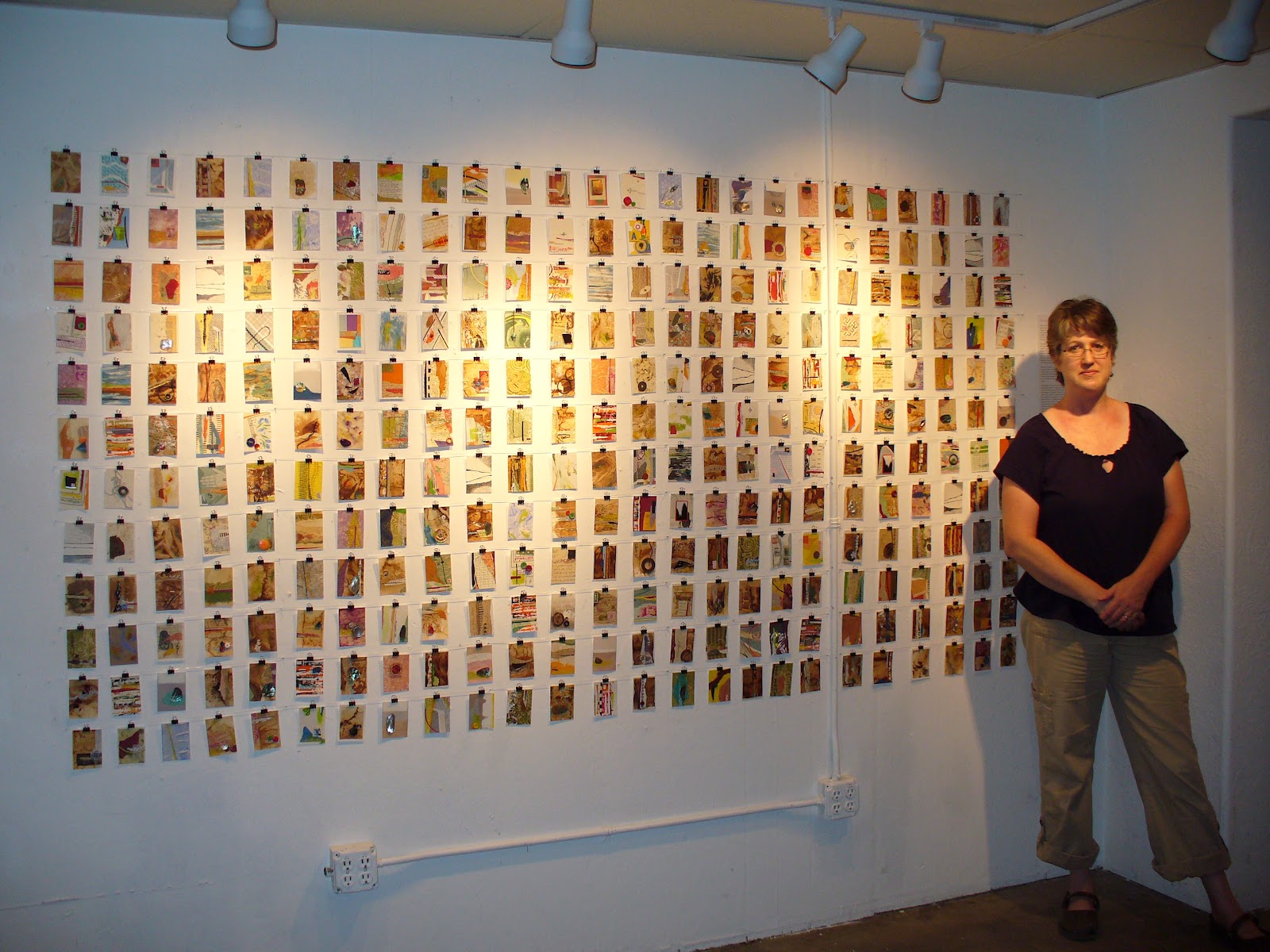
A highlight of my art card making was a year ago when I was invited to participate in a six-person art show in Durango, in which I displayed 300 of my art cards. Here is a photo of me in front of my installation.

That display took my husband and me almost five hours to install. And it was a one-night show only!

Today, I’m still making my art cards. My goal is to average one art card a day. I always document each piece and post the photo on my blog. I have also just put a few of my cards on eBay for auction.

But I am most excited about the launch of my online shop on etsy.com. Etsy, for those who are not familiar with it, is an online marketplace, much like eBay, but focused on handmade and vintage items, as well as arts and crafts supplies. My shop is called MargotGallery, which is named after my grandmother, Margot Bulkley, who always appreciated art and influenced my life-long love of the arts.

So, as you would imagine, I am quite grateful for that collage class I discovered four years ago, as I haven’t been the same since. Through my art I am able to express my creativity, I am able to escape the everyday world by getting out of my head for as long as I’m working on a collage or other art project. And I’ve had the chance to meet amazing artists and art enthusiasts. It has been and continues to be a wonderful adventure, and I recommend it to anyone.

Here's what my evaluator had to say about my speech:

Q: What strong points does the speaker already have? 
A: Well prepared, wonderful visual aids.

Q: How well did the audience get to know the speaker? 
A: Very well through your art and explanation of it.

Q: Did the speaker reflect adequate preparation? 
A: Yes!

Q: Did the speaker talk clearly and audibly? 
A: Yes -- good pace.

Q: Did the speech have a definite opening, body, and conclusion? 
A: Yes.

Q: Please comment on the speaker's use of notes. 
A: Very appropriate, allowed eye contact. Note fantastic gestures and facial expressions.

Q: Would could the speaker have done differently that would have improved their speech? 
A: I would like to hear more about how you make your cards and how they express yourself.

Q: What did you like about the presentation? 
A: I learned something new -- ATC or ACEO difference.

Oh, and according to the Ah-counter, I said no ums or ahs.